


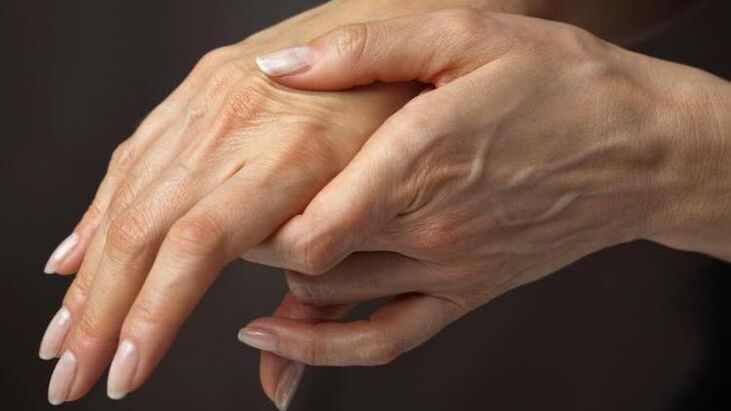
Hands are very important for a person.With their help we do almost all the work, moreover, only the graceful movements of the fingers allow us to write, draw, play musical instruments and create works of art.But it often happens that pain in the finger joints prevents us from performing familiar, everyday movements.Only then does a person begin to appreciate this part of his body.Why such a symptom develops, what it can warn us about and how to deal with it – we'll talk about it below.
Briefly about anatomy
The hand is the distal part of the human upper limb, consisting of a large number of bones, joints, muscles and ligaments.The hand is made up of 3 anatomical parts: the wrist, the metacarpus and the skeleton of the phalanges of the fingers.When we talk about pain in the finger joints we mean the proximal and distal metacarpophalangeal interphalangeal joints.These joints are the most susceptible to adverse effects of all joints in the hand due to their superficial location and high motor activity.
The metacarpophalangeal joints consist of the heads of the metacarpal bones and the base of the proximal phalanges of the fingers.The shape of the joint is spherical, which provides a range of motion in the range of flexion and extension, adduction and abduction, as well as circular rotation.
The interphalangeal joints are divided into proximal (between the proximal and middle phalanx of the fingers) and distal (between the middle and distal phalanx of the fingers).Only the skeleton of the first finger, due to its characteristics and functions, has an interphalangeal joint (since the finger is made up of two, and not three phalanges, like the others).These joints are shaped like a block, which gives them a range of motion including only flexion and extension.
Main causes of pain
If your finger joints hurt at rest or become painful during movement, you most likely have a disease that affects these structures of the musculoskeletal system.Due to normal fatigue, finger pain rarely develops.This is possible, for example, in schoolchildren after summer holidays, when the fingers have not experienced stress for a long time and in similar situations.But such pain is characterized by a feeling of fatigue, does not require treatment and quickly disappears after minimal rest.
Persistent pain in the joints of the fingers may indicate the following diseases:
- rheumatoid arthritis;
- polyosteoarthritis;
- gouty arthritis;
- psoriatic arthritis;
- stenosing ligamentitis;
- acute infectious arthritis (bacterial, viral, fungal).
Let's consider each option separately.Knowing the characteristics of a particular disease will help you in any case to suspect the true causes of pain in the joints of the fingers and prescribe the correct treatment.
Factors contributing to finger joint damage:
- presence of autoimmune diseases and disorders;
- the presence of chronic foci of infection in the body (carious teeth, chronic tonsillitis, sinusitis);
- hormonal imbalance in the body, endocrine pathology;
- diseases accompanied by metabolic disorders;
- genetic predisposition;
- history of traumatic hand injuries;
- constant negative impact of environmental factors (cold, hot water or air, vibrations);
- professional risks.
Rheumatoid arthritis
This chronic autoimmune disease of the musculoskeletal system is the most common cause of damage to small joints, especially the finger joints.The disease has a wavy course with alternating periods of exacerbation and remission.It affects patients of all ages and is observed more often in women than in men.
The initial stages of rheumatoid arthritis are characterized by pain in the small joints of the hand, sometimes it even hurts to bend the hand into a fist.An exacerbation is accompanied by inflammatory changes in the diseased joints: swelling, redness, increased local skin temperature on the diseased joints, inability to perform full mobility, first due to pain and then due to hand deformity.
A characteristic symptom of rheumatoid arthritis is pain in the hands in the morning and a feeling of stiffness.Sometimes it hurts to perform any movement for a long time: stiffness disappears by lunchtime or even in the evening.
In the later stages of the disease, irreversible changes occur in the articular and musculoligamentous apparatus of the hands with the development of typical deformities, called the hallmark of rheumatoid arthritis:
- hand with goggle;
- like a flagship;
- gooseneck;
- the fingers have a buttoning position.
With an exacerbation of the disease, general symptoms can also be observed: fever, loss of appetite, muscle pain and poor health.Rheumatoid arthritis can affect any joint in the body, but a favorite location is the finger joints.
Polyosteoarthritis
This is a chronic degenerative-dystrophic disease of the joints.Typically, arthrosis affects the large joints of the body (knees, hips, ankles), but sometimes small joints of the hands are also involved in the pathological process.In addition, symptoms occur more often in women during menopause, which confirms the relationship of the disease with the level of estrogen in the body.
Finger pain in polyosteoarthritis appears more often in the evening, after a working day and physical stress on the joints, and not in the morning, as in rheumatoid arthritis.Accompanied by a crunch in the affected joints, it rarely manifests itself with signs of inflammation.Over time, as the disease process progresses, the joints become deformed and their mobility is lost, which often leads to the inability to perform small movements and sometimes even to support themselves independently.
The characteristic signs of polyosteoarthrosis of the fingers are specific formations: Bouchard's and Heberden's nodes.Bouchard's nodes are formations that gradually develop near the affected proximal interphalangeal joints.Their preferred place of localization is the lateral surfaces of these joints, this leads to a peculiar fusiform thickening of the fingers and limited mobility in the hands.
Heberden's nodes are formations that grow on the lateral surface of the distal interphalangeal joints.Their growth is accompanied, unlike Bouchard's lymph nodes, by symptoms of inflammation and pain.As polyosteoarthritis progresses, the fingers become knotty, which can be called a pathognomonic sign of this disease.
One type of polyosteoarthritis of the fingers is rhizarthrosis.This is a lesion of the metacarpophalangeal joint of the first finger of the hand.It develops due to constant loads on this joint.Difficulties often arise when making a diagnosis, since the pathology of this localization is also characteristic of psoriatic and gouty arthritis.
Psoriatic arthritis
Contrary to popular belief, psoriasis is not just a skin disease;in 10-15% of cases the pathology manifests itself with damage to the joints.The disease manifests itself with periods of exacerbations and remissions.The preferred location is the distal interphalangeal joints.In some cases, psoriatic arthritis manifests itself as pandactylitis, when the entire finger suffers: it becomes swollen, red, hurts not only in the morning, but constantly, practically does not bend and has the shape of a sausage.Recognizing psoriatic arthritis is usually not difficult: along with damage to the fingers, typical psoriatic rashes can be observed.
Gouty arthritis
Gout is a metabolic disease characterized by a violation of purine metabolism with excessive formation of uric acid, which is stored in the form of salts in peripheral tissues and the joint capsule.Although gout primarily affects the big toe, it is also common on the toes.The metacarpophalangeal joints, especially the thumb, are involved in the pathological process.
Gouty arthritis has a paroxysmal course.During a flare-up, the pain is so severe that the patient cannot even touch the affected area.The pain is accompanied by symptoms of inflammation: swelling, redness and increased local temperature.
Painless subcutaneous deposits of uric acid salts, characteristic of gout, called tophi, can also be observed and can vary in size from barely noticeable to gigantic.
Stenosing ligamentitis
This pathology is very often confused with arthrosis and arthritis.It is based on inflammation of the annular ligaments of the fingers.This leads to pain during active and passive movements with specific clicks.X-rays help in diagnosis;pathological changes will not be visible in images with ligamentitis.As a rule, local therapy for this disease, for example, anesthetic ointment, is more effective than for other injuries.
Acute infectious arthritis
In most cases, infectious lesions present as monoarthritis: damage to one joint, rarely two or more joints are involved in the pathological process.This pathology can be caused by any pathological microorganisms that can penetrate the joint directly from the external environment, be transported through the bloodstream or penetrate from nearby tissues.Infectious arthritis manifests itself with severe pain, inflammation and disruption of the patient's general condition.
Establishing the real cause of pain in the joints of the fingers plays a very important role, because once you recognize the enemy by sight, it becomes much easier to fight it.Therefore, the treatment of joint pathology should be primarily etiological and therefore symptomatic.